Discover and Detect2026-04-03T10:49:31+02:00
Loading...

OT Network Mapping and Intelligent Detection

Map your industrial assets comprehensively, monitor your infrastructure, and detect attacks in real time using non-intrusive discovery and artificial intelligence. From one-time audits to continuous monitoring, Seclab Xplore supports your cyber maturity journey without ever disrupting operations. 

Are these challenges familiar to you? 

Lake of visibility on the OT network: incomplete inventories, unmanaged flows, and inability to demonstrate regulatory compliance.

Silos between IT and OT teams: no common reference between technical and operational perspectives, leading to misunderstandings.

Inability to effectively detect OT attacks: IT solutions are ill-suited to industrial constraints and specifics. Too much alerts, not enough OT context.

To address these issues, choose an OT-designed visibility and detection solution that provides the most comprehensive mapping available on the market. 

SEE WITHOUT DISRUPTION: A CHALLENGE IN OT 

In the OT world, each newly deployed security device brings its own set of constraints:

  • Risk of impacting the availability of critical processes
  • Deployment and maintenance complexity
  • Massive generation of false positives
  • Contractual limitations on certain OT systems

Traditional visibility and detection solutions face significant limitations in this regard.

>> Traditional solution = installation of intrusive software components on operational equipment

>> Traditional solution =
IT-oriented operation mode, difficult for industrial teams to understand, generating noise and potentially disrupting operations.

For Visibility that Truly Respects OT Specificities 

Seclab offers a non-intrusive discovery and intelligent detection approach with Seclab Xplore, the only sovereign visibility solution for industrial environments. 
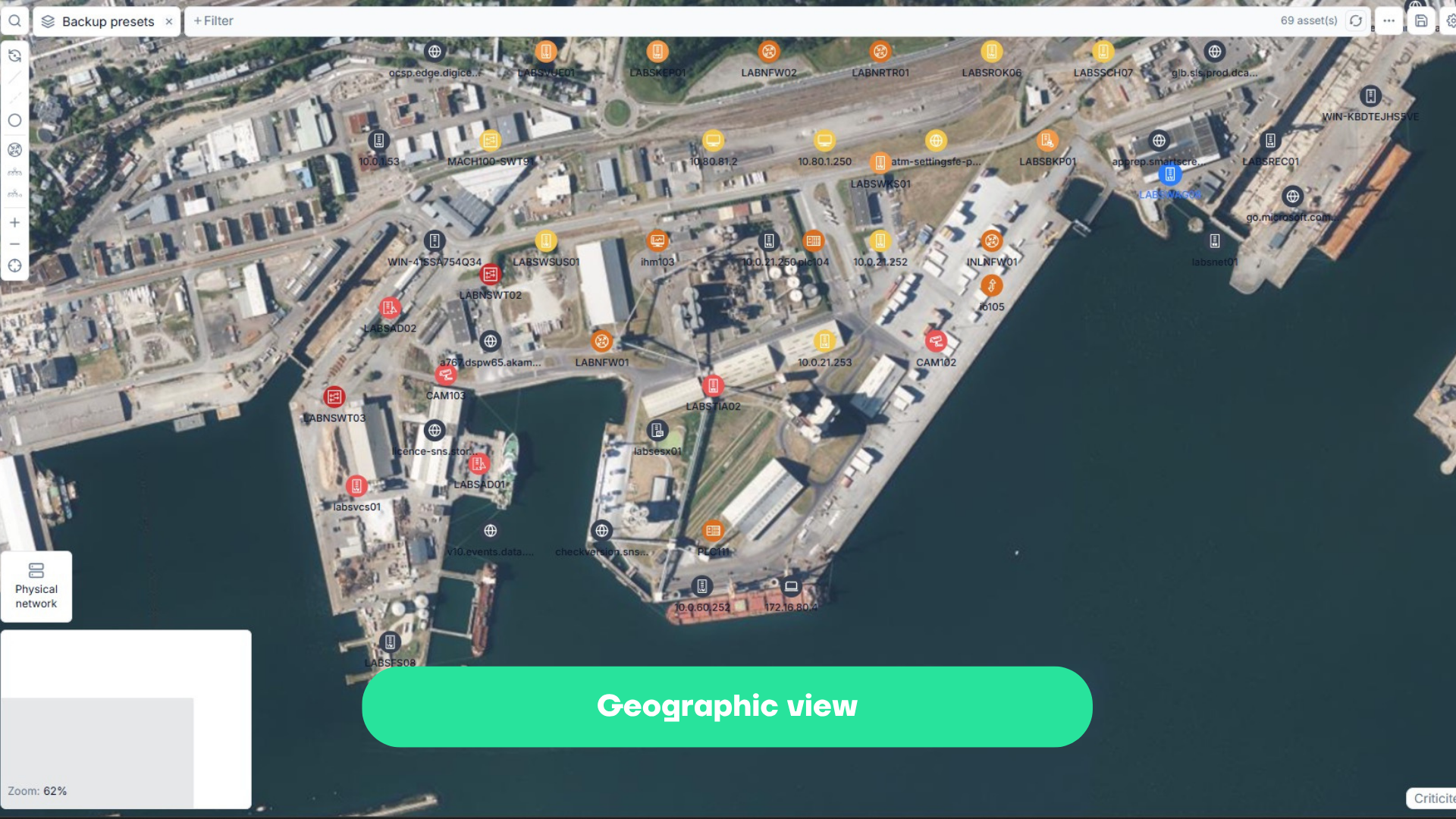
Multi-View Mapping

  1. Geographic view: spatial positioning of assets. For site managers and OT leaders.
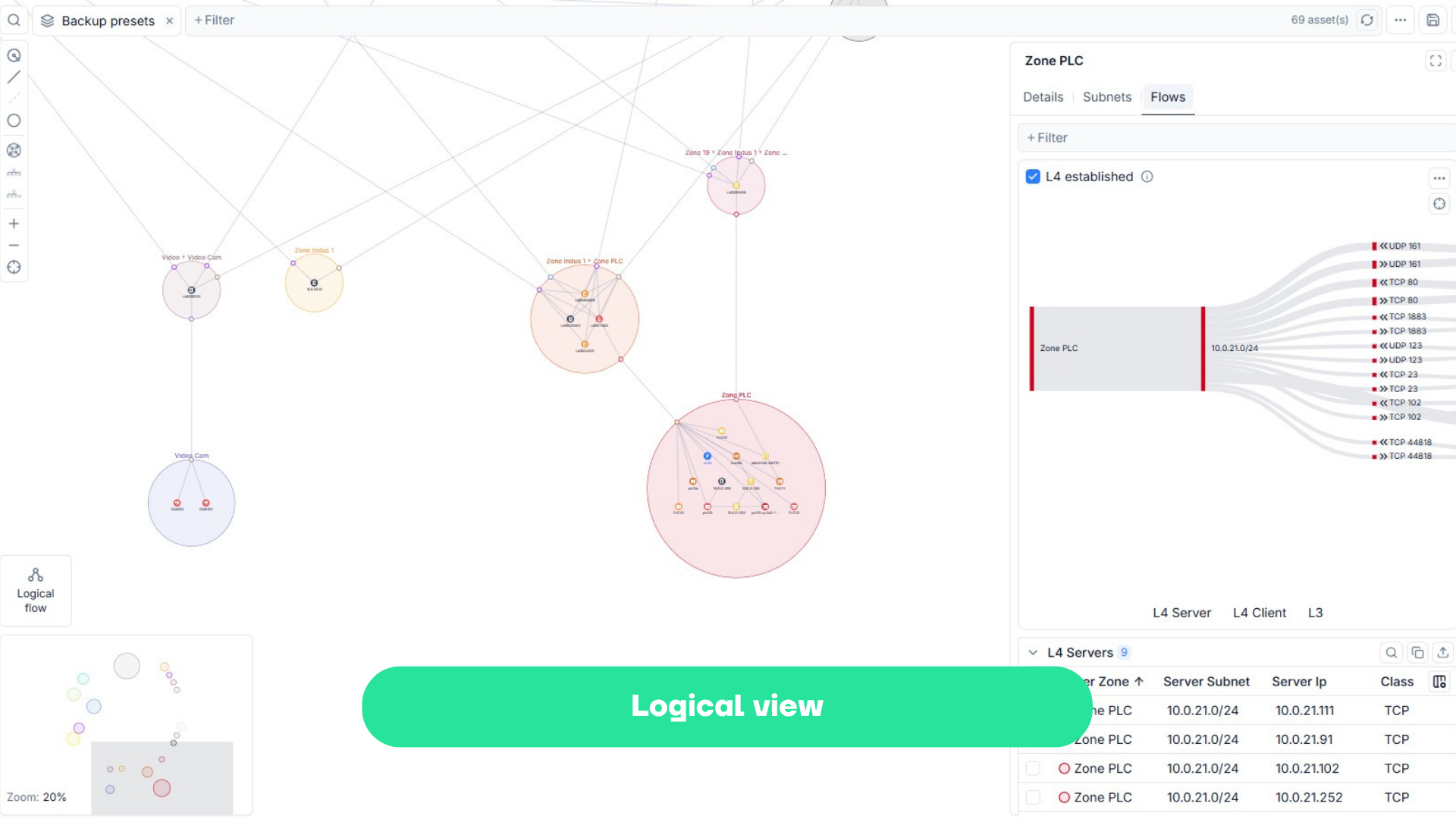
  2. Logical view: communication flows represented as zones and conduits. For CISOs and security teams.
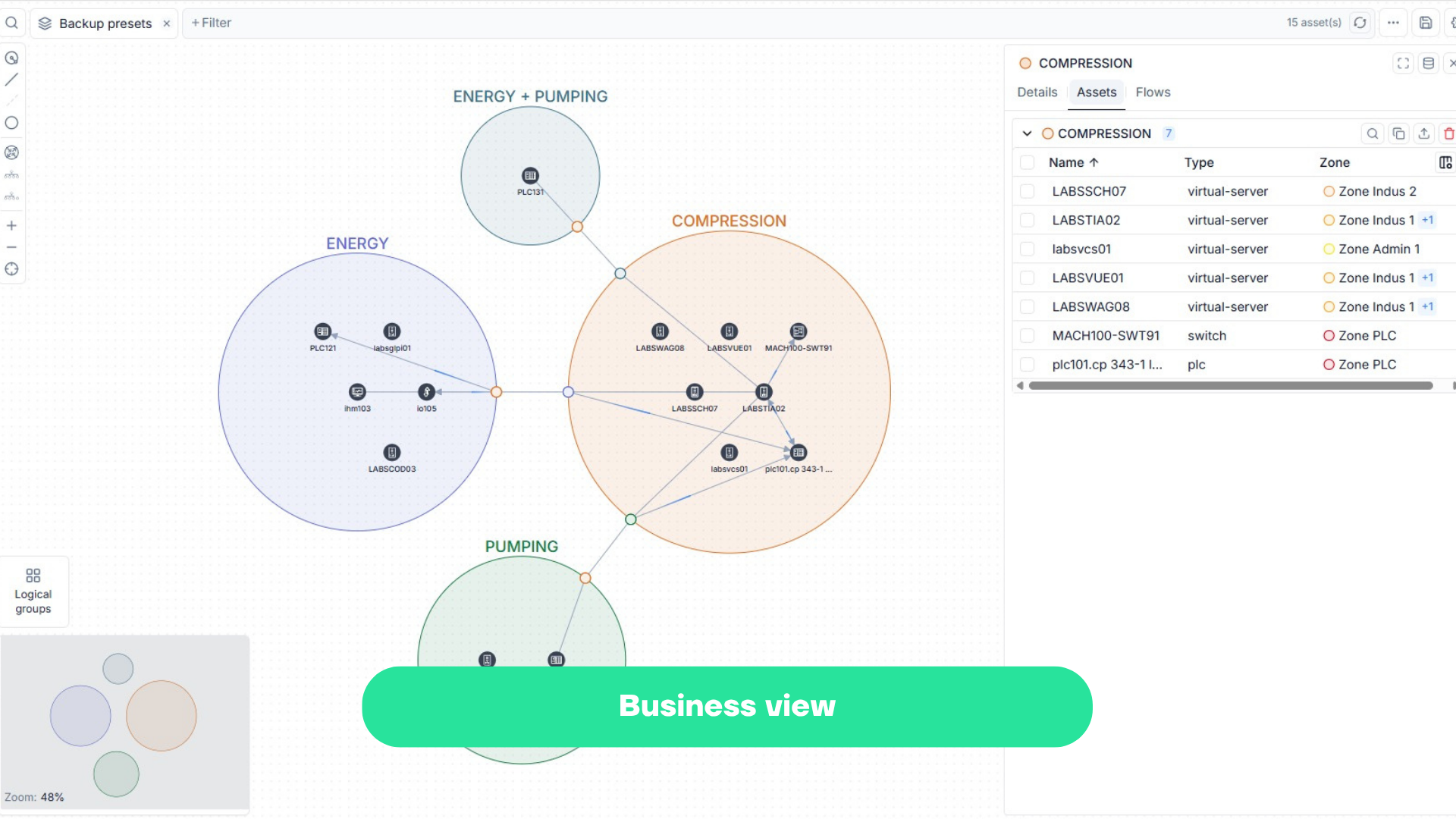
  3. Business view: functional perimeters. For automation engineers and OT managers.
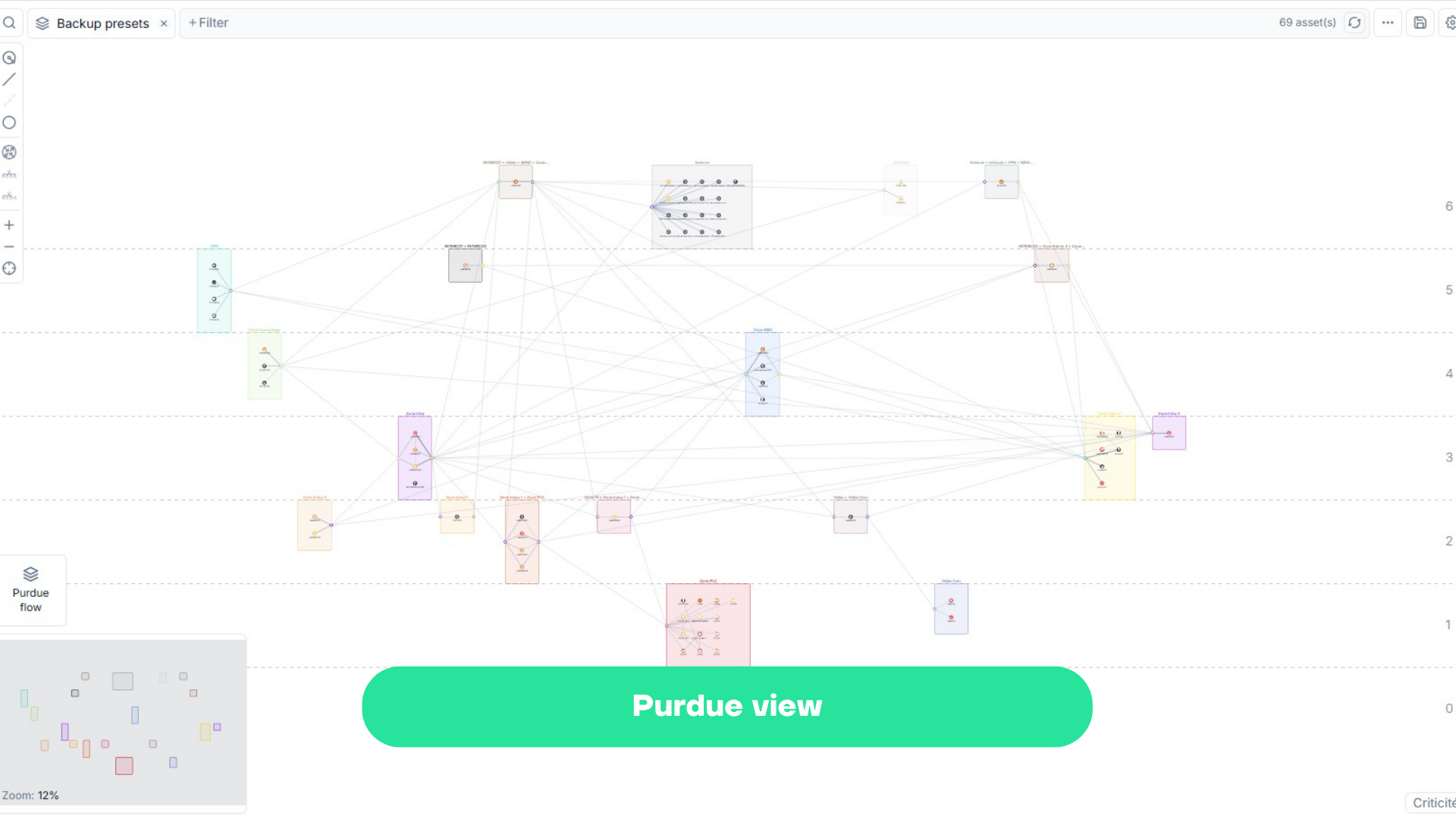
  4. Purdue view: organization according to the IEC 62443 model. For automation engineers and OT managers.
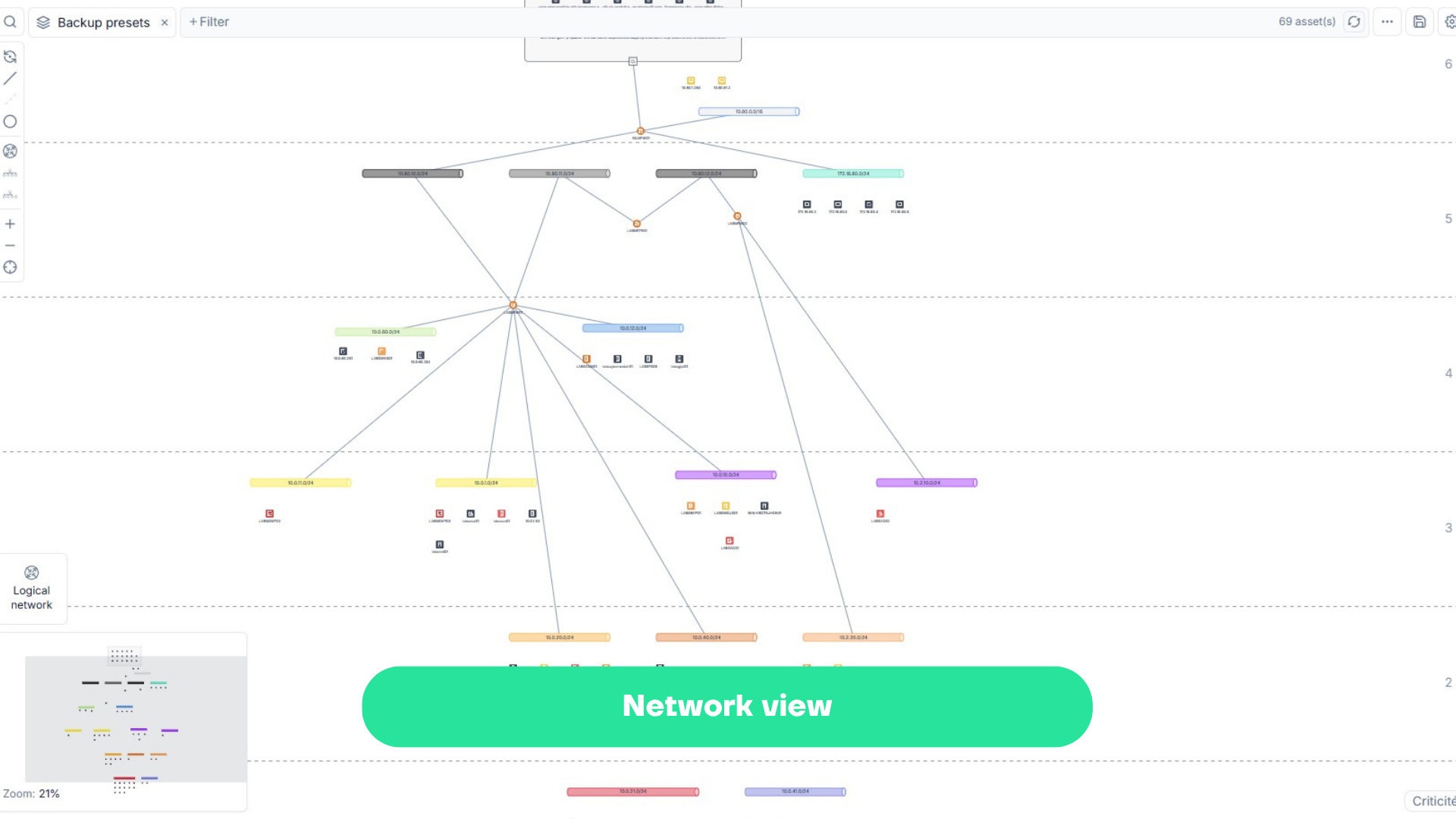
  5. Network view: classic network topology. For network engineers and system administrators.

Flow Matrix

For each asset, zone, or link, displays a representation of communications with other connected devices.

  • Communicating assets
  • Protocols used
  • Direction of communications
  • Network zones

Seclab Xplore natively inspects industrial protocols (Modbus TCP/RTU, S7comm, EtherNet/IP, OPC-DA, BACnet, DNP3, IEC 60870-5-104, PROFINET,etc.).
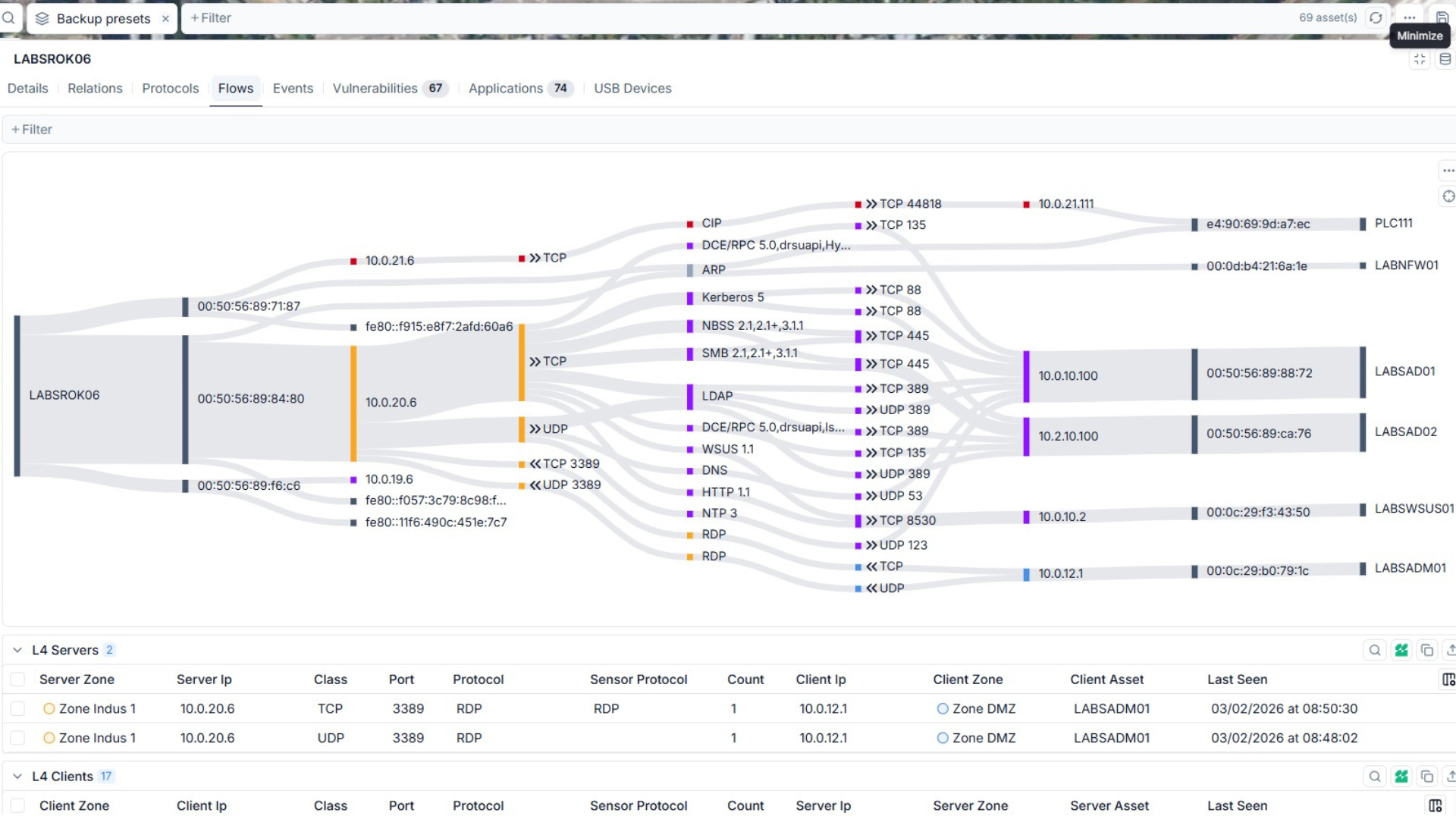
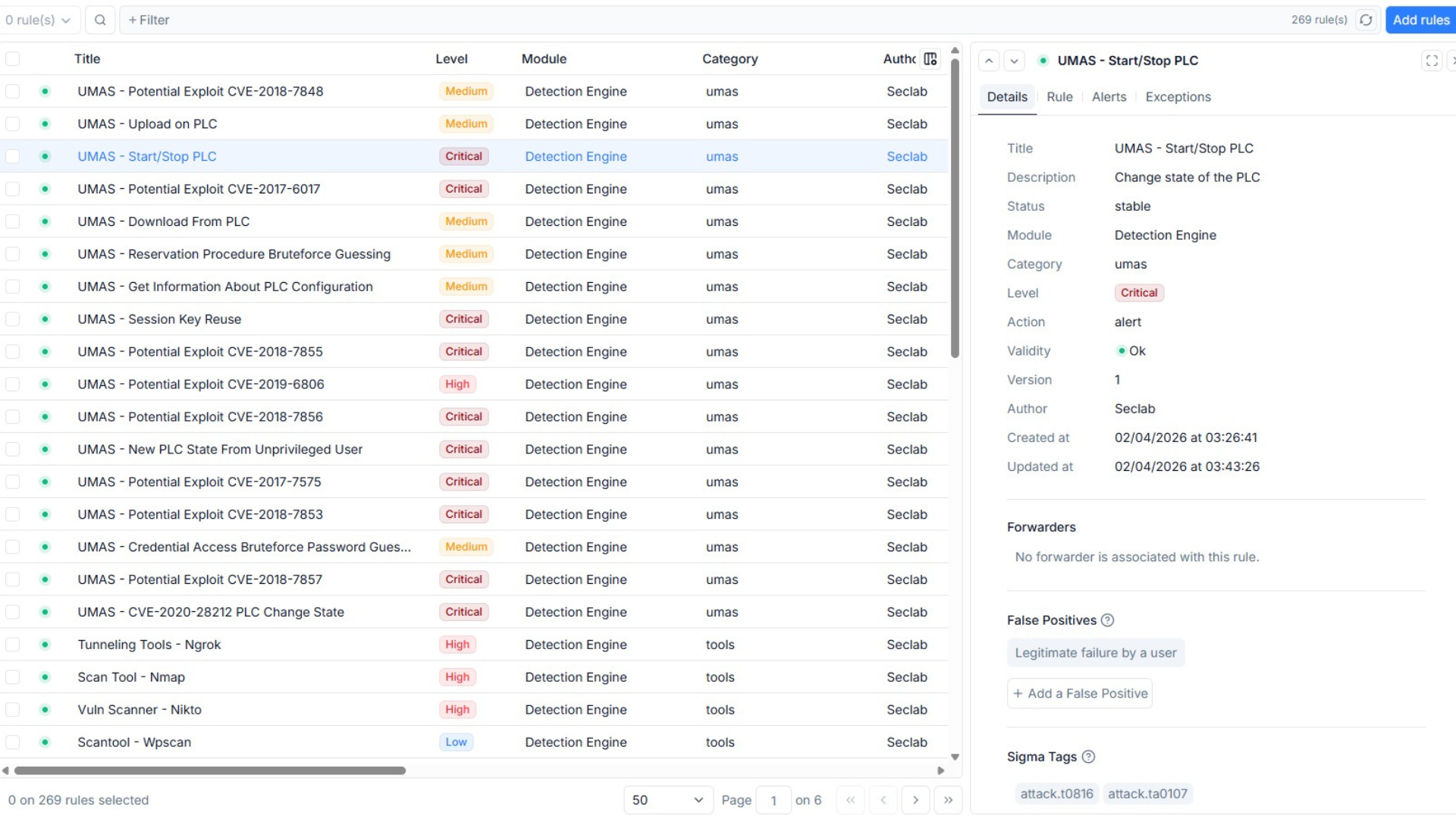
Seclab Xplore interface displaying a network flow matrix from OT network mapping

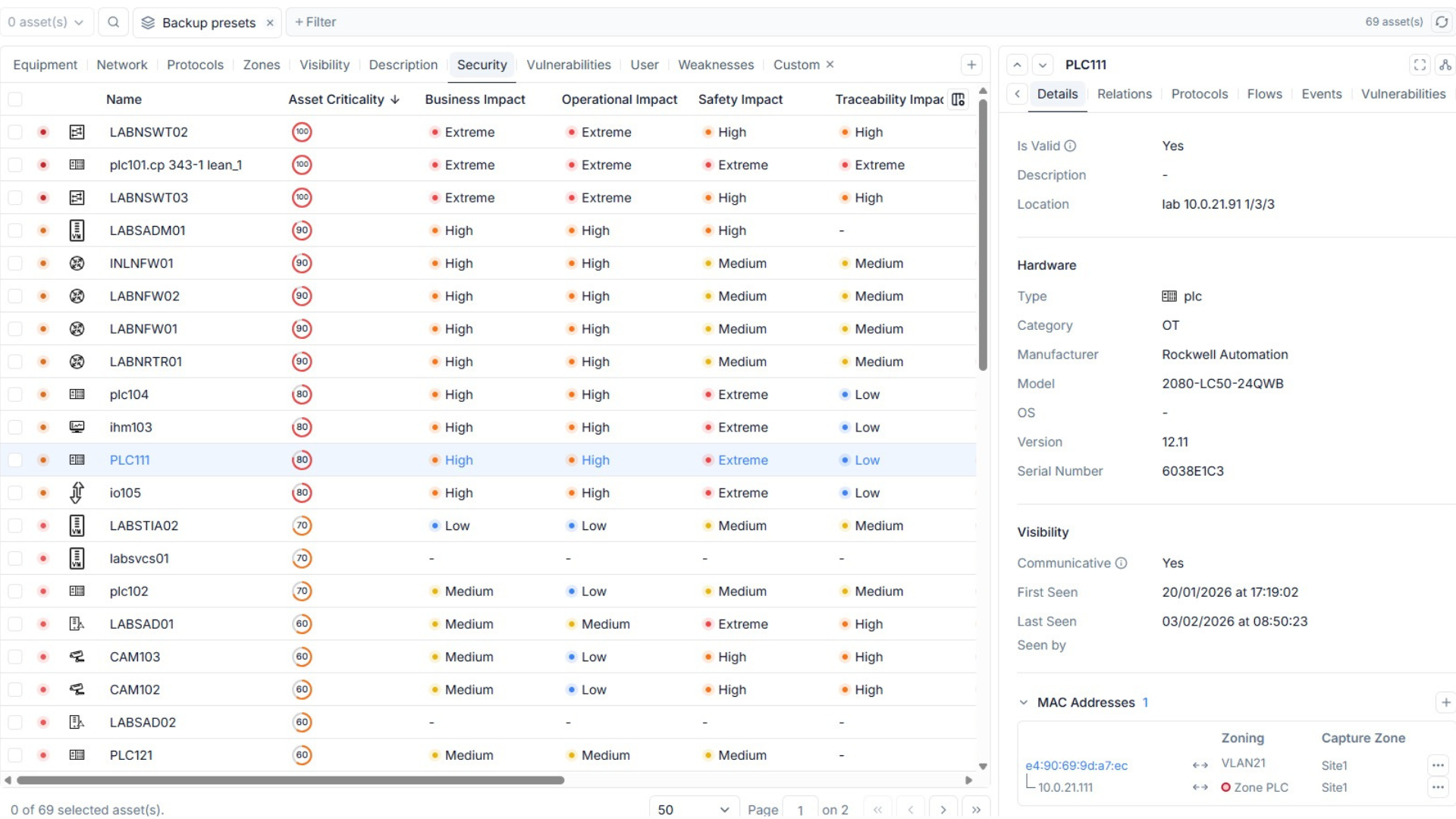
Risk-Oriented Inventory

  • Hardware type
  • Network equipment
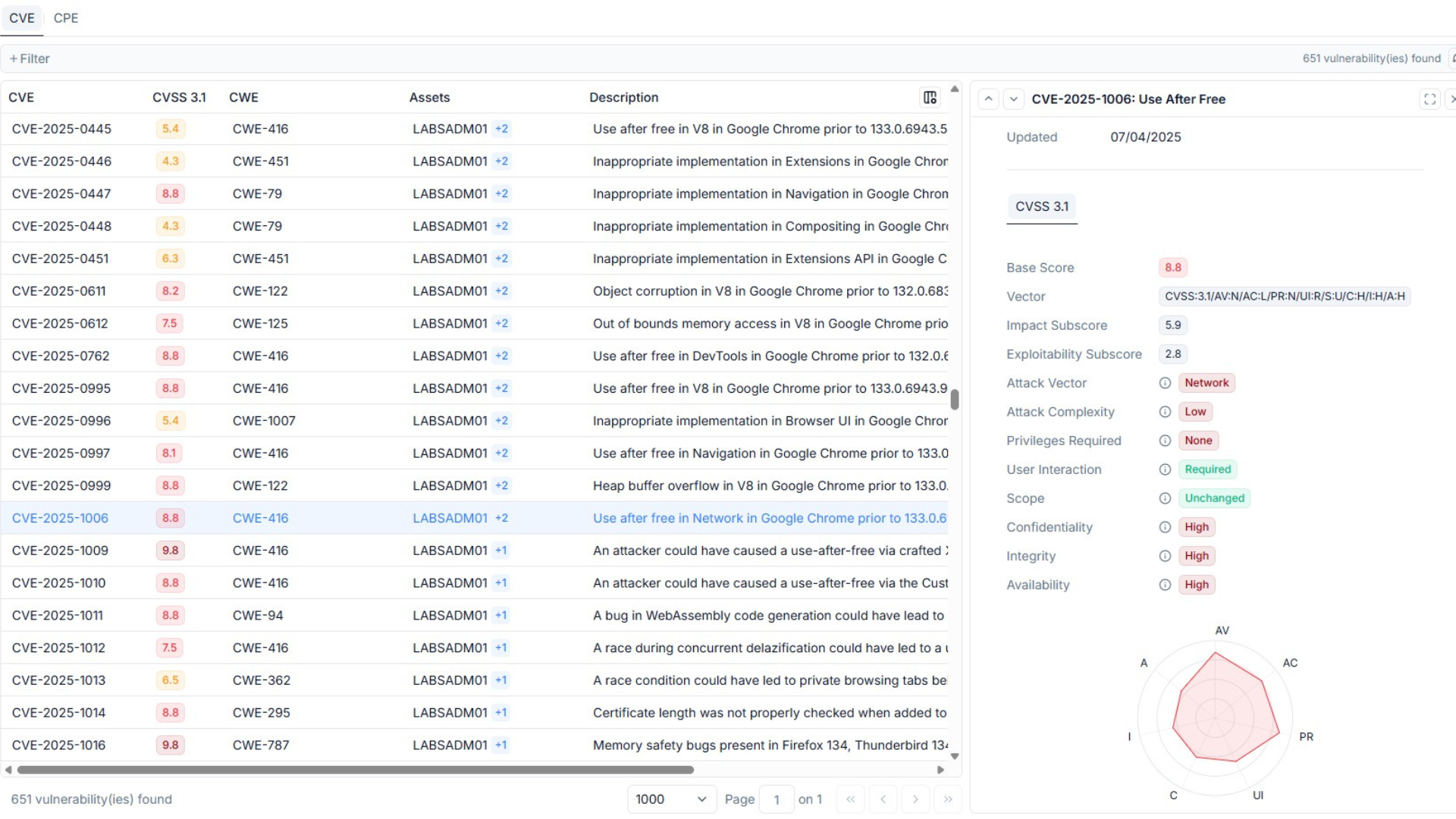
  • Asset vulnerabilities
  • Risk level assessment for each asset

Risk is evaluated according to the following criteria: business impact, operational impact, safety, traceability, availability, backup, confidentiality, integrity, and recovery priority.

Intelligent and Contextual Detection

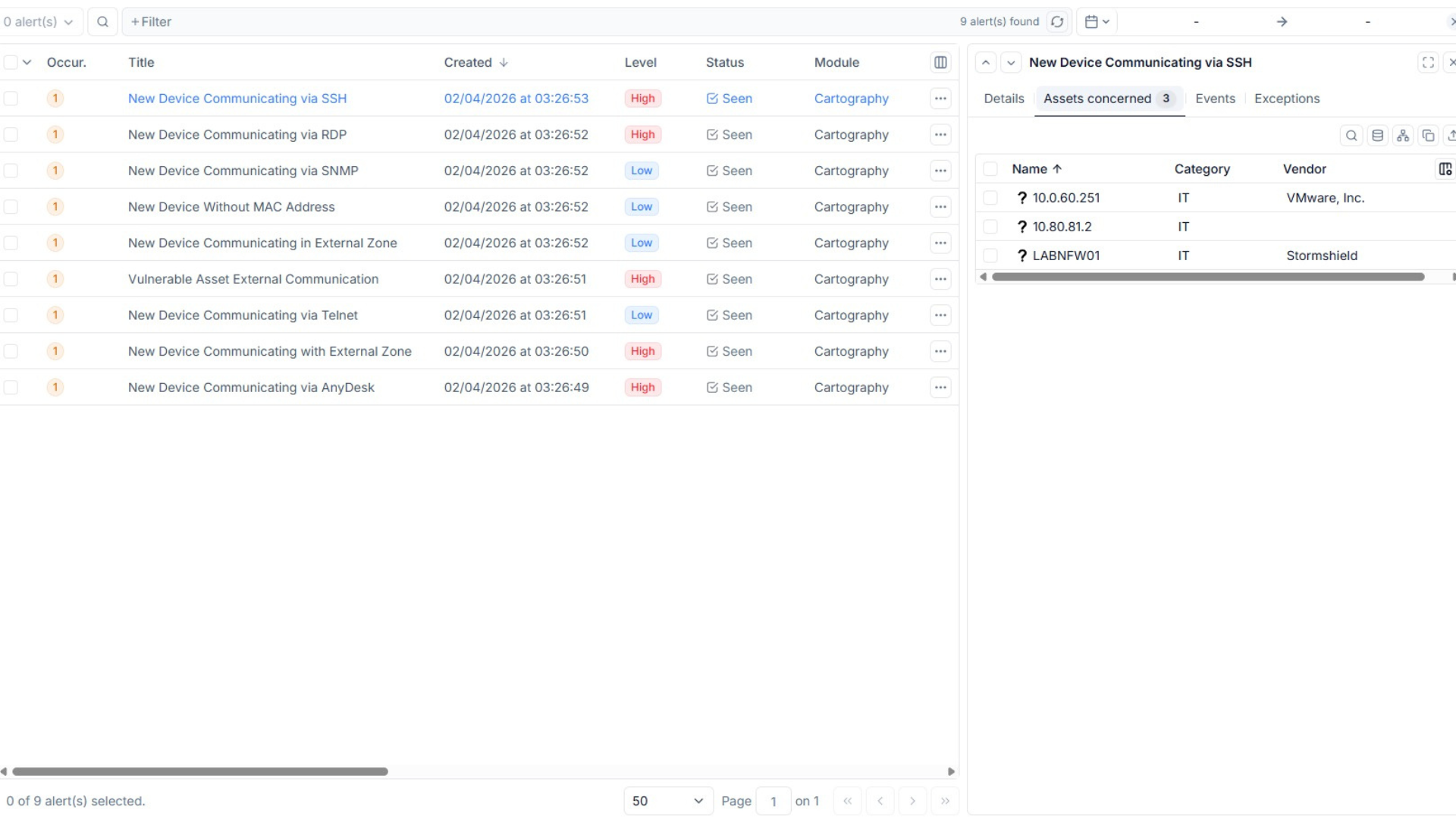
  • Cartography-based detection: identifies new assets, ports, and network flows.
  • Sigma signature detection: customizable and contextualized rules.
  • Suricata signature detection: network-based instrusion detection.
  • Behavioral detection powered by AI: learns normal patterns and identifies deviations.
Icon featuring an eye to represent the most advanced OT network mapping on the market

Unmatched Visibility 

Five mapping views generated automatically or manually from the same data. Capable of operating on core networks, non-routed networks, and isolated perimeters. 

Intelligent Threat Detection

Four complementary engines (mapping, Sigma signatures, Suricata signatures, AI behavioral) to identify anomalies, zero-day threats, and weak signals. False positives are minimized thanks to mapping-based contextualization. 
Icon representing an OT threat blocked through OT detection
Icon representing a staircase evoking the progressive increase in cyber maturity

Progressive Path 

From ad-hoc audits to continuous supervision, using the same software. Existing inventories can be enriched. Controlled initial investment, with scaling at your own pace. 

Regulatory Compliance 

Actionable data for NIS2 or IEC 62443 audit reports. MITRE ATT&CK coverage reporting. Auditable inventories, documented network maps, and complete flow matrices. Demonstrates clear control over risks.

Icon representing OT compliance
Icon representing IT and OT reconciled, to evoke IT/OT collaboration

Facilitated IT/OT Collaboration

Intelligent alert routing by recipient, collaborative mapping, and native interoperability with existing tools (firewalls, SIEM, SOC, bastions, CMDB). Each team works in its familiar operational view. 

Trusted Solution 

French solution developed and maintained in France, with full control over code, data, and roadmap. Complete sovereignty over your OT data. 

Icon representing a controlled industrial process, to evoke a sovereign OT visibility solution

Key OT Visibility Use Cases Leveraging the Unique Capabilities of Seclab Xplore 

Seclab Xplore can be deployed in a portable "briefcase appliance" mode to perform a one-time assessment: complete inventory within a few hours of passive monitoring, immediate multi-view OT network mapping, list of identified vulnerabilities, and exportable information for audit report. 

Seclab Xplore is the ideal solution for organizations starting their OT cybersecurity journey, conducting a risk analysis, or wishing to audit a third-party network before connecting it—such as during a corporate acquisition. 

By deploying fixed sensors at strategic monitoring points, Seclab Xplore enables real-time updates of the OT network map, dynamic inventory tracking, and automatic reporting of deviations from the initial mapping. Seclab Xplore is particularly suited for building management networks (BMS/BAS) evolving with ongoing works, multi-site infrastructures requiring a consolidated view, and organizations subject to regular audits. 

With its four detection engines (mapping, Sigma signatures, Suricate signatures, AI-based behavioral), Seclab Xplore identifies changes, anomalies, suspicious behavior, and intrusion attempts. Contextualized alerts can be routed to the SOC, IT teams, or OT teams depending on their criticality or context. Seclab Xplore also facilitates forensic analysis through collected and archived traffic evidence and proofs, enabling a rapid response in case of a security incident. 

Seclab Xplore simplifies the generation of deliverables that can be directly used for security audits: comprehensive and auditable asset inventories, OT network mapping documented across all five views, regular vulnerability analyses, complete flow matrices, and segmentation deviation listings. 

As part of a defense-in-depth approach, Seclab Xplore enables the immediate identification of vital assets (MVDI – Minimum Viable Digital Industry*) that require the highest level of protection. 

These assets are then secured using Seclab Xchange (network isolation) and Seclab Xport (USB isolation). Seclab Xplore also maps the critical flows that must be allowed on Seclab Xchange devices and automatically generates the corresponding Seclab Xchange configuration. 

* = MVDI – Minimum Viable Digital Industry | Scope containing only the vital assets necessary for the continuity of the business.

Seclab Xplore maps the actual OT network flows and compares them with the existing filtering rules. The flow matrix highlights overly permissive rules, unauthorized communications, and discrepancies between the theoretical segmentation and the observed reality. Recommendations can then be applied directly to the firewalls. Seclab Xplore is the ideal solution for auditing or hardening industrial firewall rules during compliance efforts, or for regaining control of an insufficiently documented OT architecture. 
Seclab Xplore can be deployed in mobile mode (portable appliance) during the commissioning of a new OT network. In just a few hours of passive monitoring, it provides an inventory of connected devices, verifies network segmentation, identifies unexpected flows, and detects vulnerabilities from the very start of operation. The information generated by Seclab Explore serves as a T0 baseline, usable as formal commissioning documentation. Seclab Xplore is the ideal solution for integrators and OT managers who want to objectively validate a new installation before it goes live into production. 


Seclab Xplore ensures that equipment configurations are correct and that any updates have been properly applied after maintenance operations. Seclab Xplore is the ideal solution for maintenance teams that need to guarantee the absence of side effects and maintain traceable validation. 
Contextualized alerts accelerate triage and decision-making during incidents. Seclab Xplore sensors index, store locally, and archive traffic captures, making investigations easier. Seclab Xplore is the ideal solution for SOC and CSIRT teams responding to crises in OT environments, where every minutes counts. 

Discover right now what is happening across your OT networks

SECLAB XPLORE – HOW IT WORKS?

Seclab Xplore operates without scanners or agents to discover assets, routing or filtering equipment, and to map network flows—without ever disrupting industrial processes. Zero impact on operational availability. The solution includes the following components: 
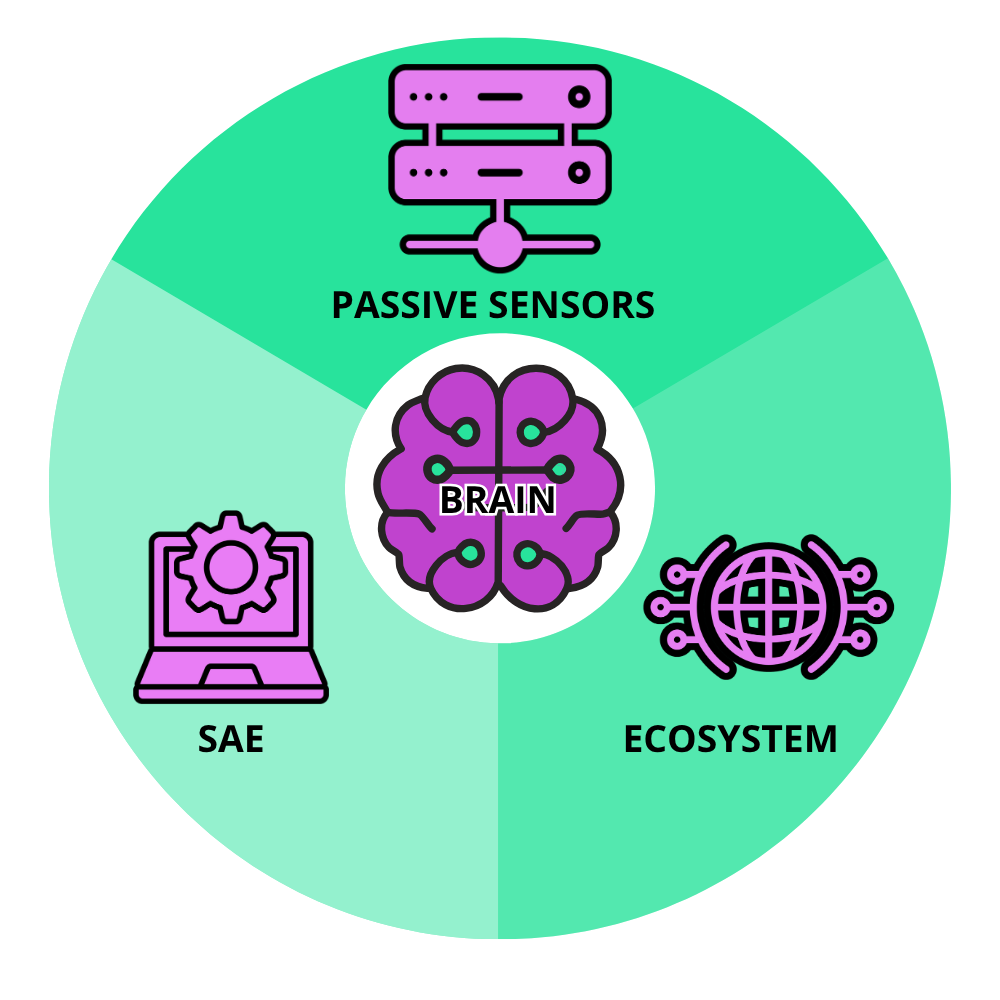
Hardware or software sensors (VMs) deployed on the OT network and connected via a mirror port (SPAN, RSPAN, ERPSAN) or a network TAP. They capture and analyze a copy of the traffic without ever interacting directly with the equipment. Thanks to support for tunneling mechanisms (VLAN, GRE), probes can be deployed remotely from the collection point. Zero port scanning, zero agents deployed. The OT network continues to operate exactly as before. Supports IPFIX and NetFlow traffic.

A centralized system for real-time analysis of traffic from sensors or locally uploaded PCAP files. The Brain includes the graphical interface for administration and visualization of OT information. Local injection of PCAP files allows mapping of completely isolated environments. The Brain is available as a physical or virtual appliance. 

Proprietary mechanisms (signed and auditable scripts or executables, requiring no installation) that enhance the inventory without disrupting operations: 

  • SAE-N: retrieves information from managed switches to locate assets on switch ports. 
  • SAE-S: provides a detailed inventory of installed applications, proactively identifies vulnerable software, tracks USB devices, and assesses asset protection levels. 
  • SAE-dv: enriches data for DeltaV machines. 

All modules are activated on demand, configurable in intensity and scope, and fully controlled by the user.

Seclab Xplore can leverage existing infrastructure and integrates with the current technology ecosystem (CMDB, Firewall, PAM, IAM, SIEM, SOAR, etc.) to enhance discovery, provide operational flexibility, and facilitate incident response. 

Diagram representing the Seclab Xplore architecture for OT mapping and attack detection

5

4

100%

Mapping Views

Detection Engines

Designed for OT

Discover right now what is happening across your OT networks

Your OT Environment Deserves Defense in Depth 

> For physical network isolation and protection of critical assets, discover  Seclab Xchange.

> For securing assets using USB devices, discover Seclab Xport.

> Xchange, Xport, and Xplore are part of the Seclab XCore Platform, providing lasting confidence in the cybersecurity of operational and industrial environments.

> Discover Seclab XCore Platform, the cybersecurity platform designed by OT, for OT.

Frequently Asked Questions

What is Seclab Xplore? The non-intrusive OT visibility and detection solution2026-04-02T09:55:44+02:00

Seclab Xplore is an intelligent visibility and detection solution for industrial (OT) networks and critical infrastructures. Fully non-intrusive, it ensures zero impact on the availability and performance of industrial processes through its See-First Intelligence approach. 

100% non-intrusive operation

Hardware or software probes connect via a mirrored port (SPAN, RSPAN, ERPSAN) or a network TAP. They capture a copy of the traffic without ever interacting with devices and send the data to the Brain for analysis. No packets are injected into the industrial network. 

Discovery, mapping, and detection

Seclab Xplore discovers all connected assets — PLCs, SCADA, HMIs, industrial switches, IoT sensors, building management systems — and maps flows with native understanding of OT protocols (Modbus, S7, OPC-UA, BACnet, DNP3, among others).
Threat detection relies on four complementary engines: 
  • Mapping-based detection: identifies new devices, configuration changes, and deviations from the baseline. 
  • Sigma and Suricata signature detection: customizable rules aligned with known threats and contextualized via network mapping. 
  • Behavioral detection: learns normal patterns and identifies deviations using artificial intelligence. 

Five mapping views for every role

The solution offers five representations — network, Purdue, logical, geographic, and business — enabling CISOs, IT engineers, OT engineers, and site managers to work in their familiar view on shared data. Seclab Xplore supports organizations from ad-hoc mobile audits to continuous monitoring, without any technological disruption. 

Key takeawaySeclab Xplore is a non-intrusive OT network mapping and detection solution. It discovers assets, maps flows (with native OT protocol support), monitors changes, and detects threats using four complementary engines – all without impacting industrial operations.

How Seclab Xplore Meets NIS 2 Compliance Requirements in OT ?2026-04-02T10:44:08+02:00

Seclab Xplore directly addresses the key NIS 2 requirements for organizations operating industrial systems: asset inventory, risk analysis, incident detection, and traceability for audits. The directive's introduction of personal liability for executives makes these capabilities essential. 

Which NIS 2 requirements are covered? 

NIS 2 Requirement  Seclab Xplore Capability 
Critical asset Inventory Passive discovery + dynamic enrichment via SAE-N and SAE-S. Complete, up-to-date, exportable, and auditable inventory. 
Risk Analysis Vulnerability assessment (CVE), segmentation analysis, identification of configuration weaknesses. Data usable for EBIOS RM and ISO 27005.
Network Segmentation Purdue view + traffic matrix to verify compliance and identify deviations. Supports decision-making for Xchange and Xport deployment. 
Incident Detection and Management  Continuous monitoring, contextualized alerts, and forensic analysis capabilities for mandatory notification reports. 
Traceability and Auditability  Complete archiving of collected data and alerts. Provides evidence for audit reports. 

Key TakeawaySeclab Xplore addresses five core NIS 2 compliance pillars: asset inventory, risk analysis, segmentation, incident detection, and traceability. The collected data directly supports decisions for strengthening security (Xchange isolation) and generating audit-ready reports. 

How to verify OT segmentation according to IEC 62443 with Seclab Xplore2026-04-02T10:47:42+02:00

Seclab Xplore enables verification and documentation of the zones-and-conduits architecture defined by IEC 62443. The Purdue view, the flow matrix, and the segmentation diagnostics provide the necessary evidence to validate compliance and prioritize corrective actions. 

Zones-and-conduits segmentation verification

The Purdue view automatically organizes equipment according to ISA-95 levels. It allows instant verification that segmentation meets IEC 62443 requirements and flags any communications crossing levels non-compliantly. 

Validation of the least privilege principle

The flow matrix exhaustively documents communications between zones. It ensures that only the necessary operational flows are allowed – in line with the least privilege principle prescribed by the standard – and highlights any unauthorized traffic. 

Diagnostics and prioritized remediation

Segmentation diagnostics identify gaps between the theoretical segmentation (as designed) and the observed segmentation (as actually deployed). Correction recommendations are prioritized according to impact. Vulnerability analysis (CVE) complements this approach by allowing remediation prioritization based on the target security levels of each zone. 

Consolidated reports are aligned with IEC 62443 requirements and are directly usable for audits. The solution pairs naturally with Seclab Xchange to ensure physical isolation of critical zones (SL-3 to SL-4).

Key takeawaySeclab Xplore verifies IEC 62443 segmentation using the Purdue view and flow matrix, identifies gaps, and produces audit-ready reports. It integrates with Seclab Xchange to physically isolate the most critical zones (SL-3/SL-4).

What is the See-First Intelligence approach? Progressive OT cybersecurity in 3 phases2026-04-02T10:53:22+02:00

The See-First Intelligence approach means "see first, comprehensively and safely, before acting." Seclab Xplore implements this through a progressive journey — from ad-hoc audits to continuous monitoring — allowing organizations to advance at their own pace without a monolithic upfront investment.

The problem with "all or nothing" 

Most OT cybersecurity solutions require a full deployment from day one: complete purchase, probes across the entire perimeter, immediate continuous monitoring. This approach slows adoption and inflates the initial budget without prior proof of value. 

Three phases to maturity 

Phase 1 – Nomadic audit: inventory in hours, with no permanent commitment
A portable appliance (suitcase format) is temporarily connected to the OT network. Within a few hours of passive monitoring, it produces a complete inventory, a five-view OT network map, a list of vulnerabilities, segmentation analysis, and a consolidated audit report. Ideal for starting an OT cybersecurity initiative, auditing multiple sites, or meeting initial NIS 2 obligations. 
Phase 2 – Continuous mapping and monitoring: real-time visibility, automatic deviation alerts
Probes are installed at strategic listening points. The network map is updated continuously: new devices, unusual flows, configuration changes — all changes are automatically flagged. 
Phase 3 — Advanced attack supervision: multi-engine detection and forensic analysis 
All four detection engines are activated (mapping, Sigma signatures, Suricata signatures, behavioral analysis). Continuous analysis identifies anomalies, suspicious behavior, and intrusion attempts. Contextualized alerts are routed to the appropriate stakeholders.

True technical continuity 

Data collected in Phase 1 feeds Phase 2, which in turn enriches Phase 3. Historical data is preserved, baselines are gradually refined, and detection rules are calibrated to the network's real behavior. For the CISO: controlled initial investment and a clear trajectory. For industrial decision-makers: visible results within weeks, with no commitment without proof of value. 

Key takeawaySee-First Intelligence is a three-phase maturity journey (nomadic audit → continuous mapping → advanced supervision) with complete technical continuity. Each phase delivers immediate value and feeds the next. 

How does Seclab Xplore facilitate cybersecurity collaboration between IT and OT teams?2026-04-02T10:58:26+02:00

Seclab Xplore acts as a bridge between the IT and OT worlds. Its five network mapping views, native interoperability with existing tools, and intelligent alert routing allow teams to work on shared data, each in their familiar representation. 

The IT/OT gap: a real challenge 

IT and OT teams have different priorities, tools, vocabularies, and technology lifecycles (3–5 years in IT vs. 15–25 years in OT). IT security policies do not directly apply to industrial environments, and CISOs often struggle to get a consolidated view of risks. 

Multi-view, collaborative mapping 

Each role sees the data in a familiar representation while still sharing the same underlying information. During security meetings, teams view the same screen but switch between views depending on the discussion. An incident visible on the network view can be contextualized in the Purdue view to understand process impact, then located on the geographic view. 

Interoperability with existing tools 

Seclab Xplore integrates natively with firewalls, SIEMs, SOCs, bastions, vulnerability managers, and CMDBs already in use. Alerts and data feed into the tools deployed by IT teams, avoiding the creation of another isolated silo. 

Intelligent alert routing 

Each alert reaches the right person at the right time, based on its nature and severity. An OT engineer is notified of a firmware change on a PLC. The CISO receives a consolidated risk summary. The network engineer is alerted to a flow that violates segmentation policies. 

Key takeawaySeclab Xplore bridges the IT/OT gap through three mechanisms: five mapping views tailored to each role, native interoperability with existing IT tools, and intelligent alert routing to the right stakeholders. 

Go to Top