USB Isolation2026-04-03T14:44:26+02:00
Loading...

Electronic Isolation of USB Ports
for Lasting OT Cybersecurity

Effectively manage threats related to removable media in your critical infrastructure and industrial environments, thanks to electronic isolation of USB ports—without any installation or modification of the existing architecture.

Are these challenges familiar to you?

Maintaining operational productivity for USB-based exchanges while protecting critical systems such as PLCs or SCADA.

Keeping obsolete legacy systems, on which no protection can be installed, without letting them become a security vulnerability.

Ensuring business continuity in the event of network failure, while maintaining manual and secure file exchanges (configuration, logs,…).

To address these challenges, the solution cannot be software-only: securing the USB vector in OT environments requires physical isolation at the point of use.

78%

of OT incidents originate from USB media*

USB is a blind spot in defense-in-depth : USB media bypass network defenses and reach directly into the most isolated systems.

Legacy systems cannot be protected by software: most PLCs, HMIs, and SCADA systems running Windows XP or proprietary OSs cannot receive patches, antivirus, or software agents.

*Honeywell Study, 2025

THE MISSING PIECE OF YOUR OT USB PROTECTION

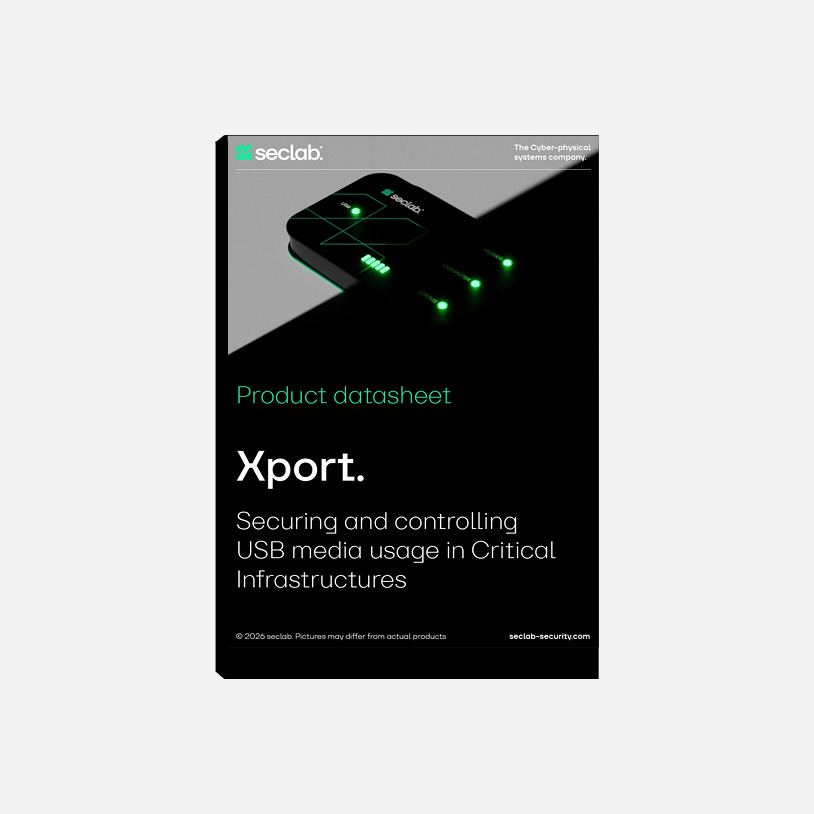
Seclab Xport physically sits between the USB device and the critical system port.

The USB device is never plugged in directly: the Seclab Xport hardware creates a complete break in the direct USB connection. The protected system only sees a virtual USB key presenting files that comply with the security policy. Seclab Xport requires no installation and no changes to the host system.

>>White stations are not enough: they analyze file content upstream but do not control what actually happens at the point of use, at the asset level.

>> Workstation locking devices or software protection solutions are too intrusive and can affect the proper functioning of the system.

OT-Designed USB
Exchange Security

Seclab offers an innovative approach to physical isolation of USB ports with its removable Xport device, based on Electronic AirGap technology.

ELECTRONIC AIRGAP

Patented hardware technology providing a fully sealed physical separation between the port and the USB device, while enabling secure file exchange.

ELECTRONIC PROTOCOL BREAK

  • Protection against zero-day attacks
  • Physical separation of environments
  • Immutable operation

ELECTRONIC AIRGAP

Patented hardware technology providing a fully sealed physical separation between the port and the USB device, while enabling secure file exchange.

ELECTRONIC PROTOCOL BREAK

  • Protection against zero-day attacks
  • Physical separation of environments
  • Immutable operation
Icône présentant la bidirectionnalité de la politique de protection USB OT

OT USB Protection Policy

Configurable for inbound only (updates, configuration files), outbound only (log extraction), or bidirectional, the security policy allows filtering of file extensions.

Lasting OT Confidence

As soon as the device is plugged into the USB port, the host system is protected. No installation is required, and no maintenance operations are needed. Plug-and-Protect.

Icône représentant le maintien de la protection USB OT dans le temps
Icône représentant une signature électronique vérifiée par l'isolation USB

Signature Control

In addition to a sanitization station like Tyrex, only files with a valid signature issued by the station can be presented to the system. Unsigned files or files modified after signing will be rejected.

Multi-System Compatibility

Compatible with Windows, Linux, and macOS, the device can also be connected to locked legacy systems running Windows XP or proprietary OSs.
Icône représentant quatre pièces de puzzle pour évoquer la compatibilité de la protection USB OT
Icône représentant la maîtrise du process industriel de fabrication de la protection USB OT

Trusted Solution

Sourcing, design, PCB routing, software development, and assembly are all performed by Seclab in France. Electronic boards are manufactured in Europe.

USB Attack Prevention

Covers all threats related to physical USB media, including BadUSB and boot sector attacks that antivirus software and sanitization stations cannot detect.
Icône représentant une attaque bloquée pour illustrer l'efficacité de la protection USB OT

Key Use Cases for OT USB Protection via Electronic Isolation

To protect the assets vital for maintaining the operational continuity of your organization (Minimum Viable Digital Industry – MVDI).

Firmware updates for PLCs, field devices, and embedded systems are often performed using USB media. Seclab Xport ensures that only update files with a valid cryptographic signature and an authorized extension can be presented to the system, while physically isolating the USB port against USB media–related attacks.

Obsolete legacy systems pose a proven threat to the entire OT infrastructure. These devices, running on outdated operating systems such as Windows XP or on locked proprietary OSs, can no longer receive security updates or host protection software. Seclab Xport allows these machines to be isolated while maintaining file exchanges with the outside world.

Seclab Xport enforces compliance with the USB security policy for all users, whether internal technicians or external contractors. The hardware device only allows compliant files to pass through, without relying on user awareness or individual goodwill.

Configured in outbound-only mode, Seclab Xport allows data to be extracted from the protected system to the USB device, preventing any file write operations in the opposite direction.

In addition to a Seclab Xchange on the main network path, Seclab Xport serves as a backup path. In the event of a network failure, file exchanges switch to the USB path while maintaining the same level of electronic security.

This failover does not compromise the level of trust, ensuring business continuity.

In deliberately network-isolated environments (air-gapped), USB media is often the only means of data exchange. Seclab Xport physically isolates and protects this single remaining entry point, operating autonomously without any network connectivity.

Seclab Xport directly addresses the requirements for controlling removable media prescribed by the main OT cybersecurity frameworks.

NERC CIP: strict controls on removable media in industrial control environments within the energy sector.

IEC 62443: physical isolation of the USB port, cryptographic signature verification, blocking of advanced threats, and enforcement of least-privilege principles for USB exchanges.

NIST 800-53: restriction of authorized file types, transfer direction control, and protection against threats introduced via removable media.

NIST 800-82: industrial control system security, including hardware-enforced and non-bypassable controls on removable media usage.

Protect What’s Vital to Your Business.

BENCHMARK

Hardware Alternative to USB Security Solutions

Operational Capabilities
USB Sanitization Station Only
USB deactivation (DLP/GPO)
Endpoint Antivirus
Seclab Xport
Physical isolation of USB port
No No No Yes
Protection against USB attacks No Partial No Yes
Boot sector protection No Yes Partial Yes
Guarantee file is scanned before use
No No No Yes (crypto signature)
No installation on host system
Yes No No Yes
Protection of legacy systems Partial No No Yes
Legitimate USB operations preserved Yes No Yes Yes
Not bypassable by malware No No No Yes
Direction control (inbound / outbound) No Partial No Yes
Anti-malware analysis within files
Yes Partial Yes No (handled upstream)
User bypass possible No No No Yes
Filtering of unauthorized file extensions
Yes No Yes Yes

ADDITIONAL RESOURCES

Your OT environment deserves defense in depth

> For physical network isolation and protection of critical assets, discover Seclab Xchange.

> For discovering your OT infrastructure and detecting threats or anomalies, discover Seclab Xplore.

> Xchange, Xport, and Xplore are part of the Seclab XCore Platform, providing lasting confidence in the cybersecurity of operational and industrial environments.

> Discover Seclab Xcore Platform, the cybersecurity platform designed by OT experts for OT environments.

Protect What’s Vital to Your Business.

Frequently Asked Questions

What is USB port electronic isolation with Electronic AirGap?2026-04-01T22:41:32+02:00

Electronic AirGap USB is a hardware device patented by Seclab that creates a complete physical break between a USB device and the protected system. The device is never connected directly to the critical system port—security relies on electronics, not software.

A fundamental principle: the device never touches the system

Unlike software-based USB port control (GPO, endpoint agents), Seclab Xport physically sits between the device and the host system. The USB device connects to the Seclab device, which analyzes and filters files according to the defined security policy. The protected system interacts only with a virtual USB drive presented by Xport, containing exclusively authorized files.

Why physical isolation outperforms software control

Software-based controls (antivirus, USB agents, application whitelisting) can be bypassed, disabled, or rendered obsolete by zero-day vulnerabilities. Physical isolation eliminates these risks by design: no direct communication is possible between the device and the system, regardless of the host software state. Protection does not degrade over time and does not depend on updates.

Key takeawaySeclab Xport ensures electronic isolation of the USB port: the device never has access to the protected system. Only files authorized by the security policy are presented to the system via a virtual USB drive.

How Does Seclab Xport Protect Against BadUSB Attacks?2026-04-01T22:42:58+02:00

Seclab Xport neutralizes BadUSB attacks by design. Since the malicious device has no direct access to the protected system’s port, the attack is physically ineffective—regardless of how sophisticated the compromised firmware is.

What is a BadUSB attack?

A BadUSB attack exploits the firmware of a USB device to turn it into a malicious tool: simulating a keyboard to inject commands, emulating a network interface to intercept traffic, or executing arbitrary code. These attacks operate at the USB protocol level, below the file layer. They are undetectable by antivirus software and file-scanning stations, as no malicious file is involved.

Why electronic isolation is the only reliable protection

Software-based solutions (device whitelisting, USB class filtering) rely on information declared by the device itself—information that compromised firmware can falsify. Seclab Xport takes a fundamentally different approach: the device is connected to the Seclab system, never to the target system. The system only sees a virtual USB drive presented by Xport. No keyboard emulation, network interface, or other USB class can reach the protected system, because the physical break prevents any direct communication.

Key takeawayBadUSB attacks are undetectable by antivirus tools because they exploit firmware, not files. Electronic isolation with Seclab Xport is the only approach that neutralizes them by design, by removing any direct access between the device and the system.

Is software or a driver required for USB isolation with Electronic AirGap?2026-04-01T22:45:52+02:00

No, no installation is required. The protected system sees Seclab Xport as a standard USB drive. No software, no driver, and no modification of the host system are needed.

Plug & Play across all OS, including legacy systems

Seclab Xport works natively on Windows, Linux, and macOS, with no host-side configuration. It is also compatible with locked-down legacy systems—Windows XP and proprietary industrial OSs—where installing an agent or driver is impossible or prohibited. This is a decisive advantage in OT environments, where critical systems often run on outdated but non-replaceable operating systems.

Security that does not degrade over time

Since protection is hardware-based (physical break + electronic access control), it does not rely on signature updates, software patches, or host system maintenance. A Seclab Xport deployed today will provide the same level of protection in five or ten years, without intervention.

Key takeawayZero installation, zero drivers, zero host system modification. Seclab Xport operates as Plug & Play on Windows, Linux, macOS, and locked-down legacy systems. Hardware-based protection does not degrade over time.

How does interoperability between TYREX stations and Seclab Xport work?2026-04-01T22:47:27+02:00

Interoperability is based on a cryptographic signature mechanism: the TYREX station analyzes and signs clean files, while Seclab Xport verifies this signature and only allows validated files to pass through. Any unsigned file or file modified after analysis is systematically rejected.

Signature mechanism in detail

When a file passes through a TYREX station (or another Seclab Xport in file transfer mode), it is analyzed and then cryptographically signed. This signature file certifies that the original file was checked and deemed safe at a given point in time. Seclab Xport recognizes this signature and authorizes the transfer to the protected system. Any file without a signature—whether added after analysis or never processed by the station—is rejected.

Transparency for the host system

The device removes the signature file before presenting the original file to the host system, ensuring native compatibility with industrial applications.

Key takeaway — TYREX analyzes and signs, Xport verifies and allows. Unsigned files are rejected. The signature is removed before presentation to the host system, ensuring seamless compatibility with industrial applications.

How does USB isolation contribute to IEC 62443 and NERC CIP compliance?2026-04-01T22:49:41+02:00

Seclab Xport meets the removable media control requirements of IEC 62443 and NERC CIP through electronic USB port isolation, non-bypassable hardware access control, and built-in audit evidence.

IEC 62443 compliance: removable media control

The IEC 62443 standard identifies removable media as a potential attack vector in industrial environments. It requires strict control over their use, including restriction of authorized file types, port access control, and enforcement of the principle of least privilege. Seclab Xport addresses these requirements through:

  • Physical isolation of the USB port: the device has no direct access to the system.
  • Access control via cryptographic signature: only pre-validated files are allowed through.
  • Blocking of protocol-level attacks (BadUSB): neutralized by the physical break.
  • Least privilege enforcement: only explicitly authorized file types and transfer directions are permitted.

NERC CIP compliance: hardware isolation and auditability

For operators of electrical infrastructure subject to NERC CIP, Seclab Xport provides a hardware-based isolation and access control mechanism that cannot be bypassed—even by users with administrative privileges. The device generates auditable logs for each transfer (authorized file, rejected file, timestamp, device identity), which can be used to demonstrate compliance during regulatory audits.

Key takeaway — Seclab Xport covers IEC 62443 and NERC CIP requirements for removable media: physical isolation, hardware-based access control, BadUSB protection, least privilege enforcement, and full audit traceability.

How to Effectively Secure OT Infrastructures Against USB Threats?2026-04-01T22:51:26+02:00

Securing USB ports in OT environments relies on three steps: mapping assets and identifying USB ports, physically isolating critical ports, and continuously monitoring deviations and anomalies. This progressive approach enables increased maturity without compromising availability.

Step 1 — Map assets and ports (visibility)
You can only protect what you know. Seclab Xplore maps connected assets and identifies available USB ports. This visibility helps identify critical systems with exposed USB ports and prioritize protection efforts.

Step 2 — Isolate critical USB ports (protection)
Once sensitive assets are identified, Seclab Xport is deployed on the most critical systems. Physical isolation of the USB port completes the trust chain with upstream sanitization solutions such as TYREX stations: only analyzed and cryptographically signed files reach the protected system. BadUSB attacks are neutralized by design.

Step 3 — Continuously detect deviations (monitoring)
Seclab Xplore provides continuous monitoring of the environment: detection of new assets, new ports, and unusual behavior. In OT, network and system changes are infrequent—anomaly-based detection is more effective and generates fewer false positives than exhaustive threat hunting. Xplore can also detect whether machines have been connected to USB devices other than Seclab Xport.

This step-by-step approach, enabled by the Seclab Xcore Platform (Xplore for discovery and detection, Xchange for network isolation, Xport for USB protection), allows organizations to progressively increase their cybersecurity maturity while respecting the operational constraints of industrial environments.

Key takeaway — Secure OT USB ports by: detecting ports (Xplore), physically isolating them (Xport + TYREX), and monitoring deviations (Xplore). This progressive approach, powered by the Seclab Xcore Platform, aligns with industrial availability constraints.

Go to Top